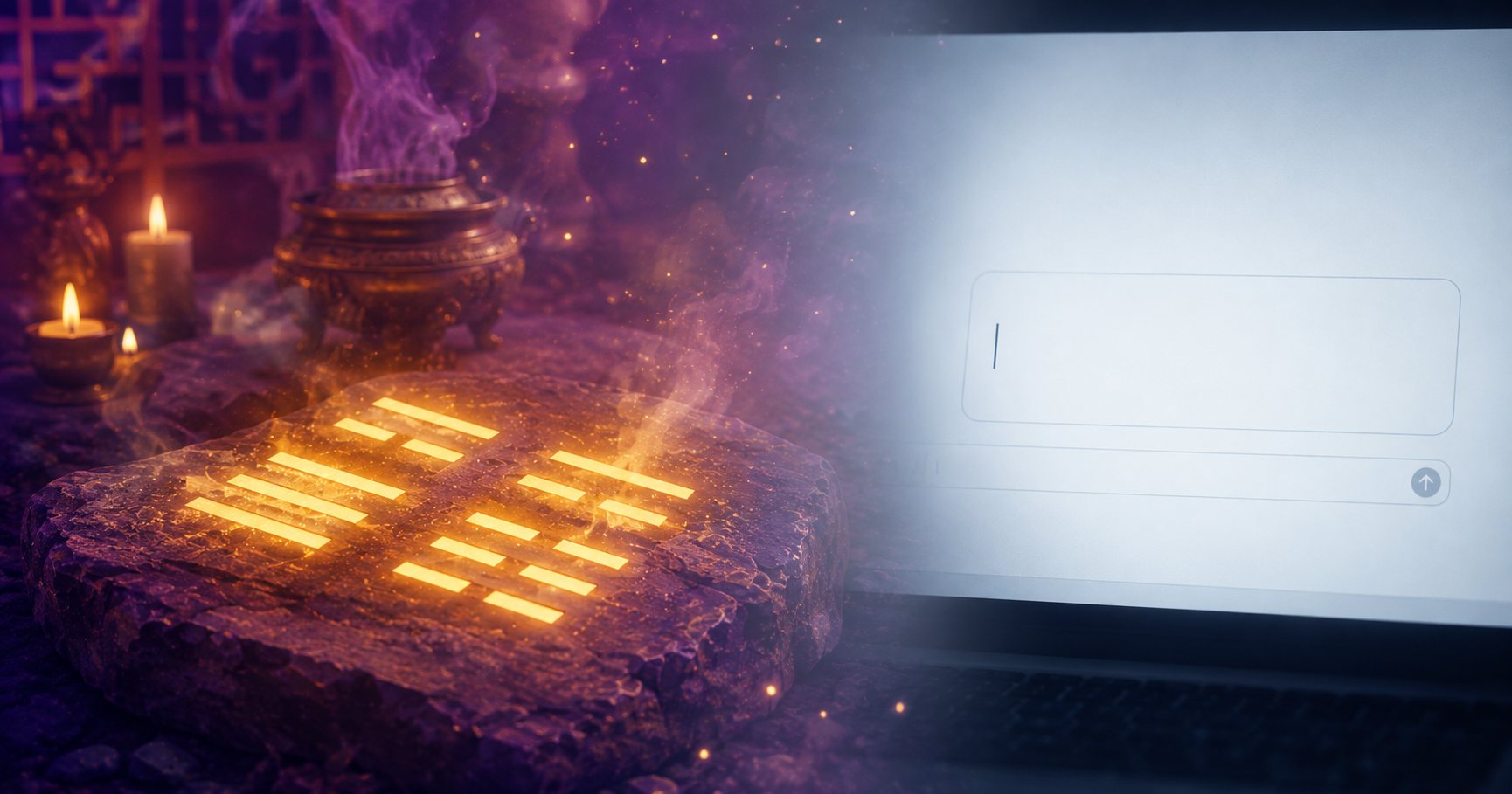
If you've ever asked an "I Ching question" — say, to ChatGPT — you probably got an answer. It sounded wise. Probably encouraging, too. But here's a question worth sitting with: was it really responding to your situation — or just saying something that sounds like wisdom, regardless of what you asked?
The traditional method — and why it's the starting point
In traditional I Ching practice, the order is always the same:
- first, there's a question or theme you're seeking guidance on,
- then comes the draw (traditionally with coin tosses or yarrow stalks),
- and only after that, once you know the specific result, do you receive an interpretation.
HexaInsight simulates this exact order digitally: the draw is a genuinely random process that builds your hexagram in six steps, the traditional way (and identifies which lines are changing) — the AI only steps in afterward, to interpret that specific result.
This matters because some AI-based tools flip this order: you describe your situation, and the AI decides which hexagram "fits" it — but that's no longer a draw, it's an AI guess with no random element at all. An independent analysis of over 3,800 ChatGPT-generated I Ching interpretations found something similarly telling: the answers were almost always "cautiously optimistic" — regardless of which hexagram came up. If the interpretation stays roughly the same no matter the actual result, that suggests the system isn't really responding to the hexagram at all.
HexaInsight's system knows the rules of hexagram interpretation — not just how to talk about them
Classical I Ching interpretation has its own rules: which line carries what weight, how to read it when one or several lines are changing, and how the hexagram transforms into its new state based on those changing lines. The system behind HexaInsight is specifically trained and tested on these rules — for example, when two lines change in a single draw (as in Tünde's story), it knows which line carries the primary message and how the two should be read together. A general AI chat doesn't "know" this in any real sense — it improvises every single time, often inconsistently.
Your questions don't disappear into a chat window
An AI chat conversation about your situation lives and dies in that one chat — hard to meaningfully compare with the next one. Some AI-based I Ching tools even advertise that they store nothing from your conversations — a fair privacy choice, but we believe that recognizing your own patterns comes precisely from having something to look back on. That's why HexaInsight keeps a journal of your readings and questions (accessible only to you, no one else): you can look back, notice recurring themes, and compare how today's draw connects to one from a month ago.
A curiosity: when you don't even ask a question
We've noticed a recurring pattern worth sharing: fairly often, someone draws without entering a question or a specific topic at all — and the hexagram that comes up, along with the AI's interpretation, still ends up connecting surprisingly precisely to whatever is actually on their mind. Some describe this as a kind of quantum entanglement; others point to the "observer effect" known from quantum physics, where our attention and expectation shape what we notice in the world. We don't have scientific proof of what's really behind this — but as a phenomenon, it's thought-provoking, and for many people, it's part of why they keep coming back to a reading.
It's an experience, not a text box
Watching your hexagram take shape — the lines appearing, the changing lines highlighted — is itself part of what makes the process feel like a draw, not just an answer. A general chat window was never built for that.
None of this means a general AI chat is "bad" — plenty of people use one to casually explore the I Ching, and that's a perfectly good way to satisfy curiosity. The difference is what HexaInsight is actually built on: a faithful, digital simulation of the traditional method — a real draw, interpreted specifically and by the rules, preserved over time.